
DG-03Product sheet
Diagnose
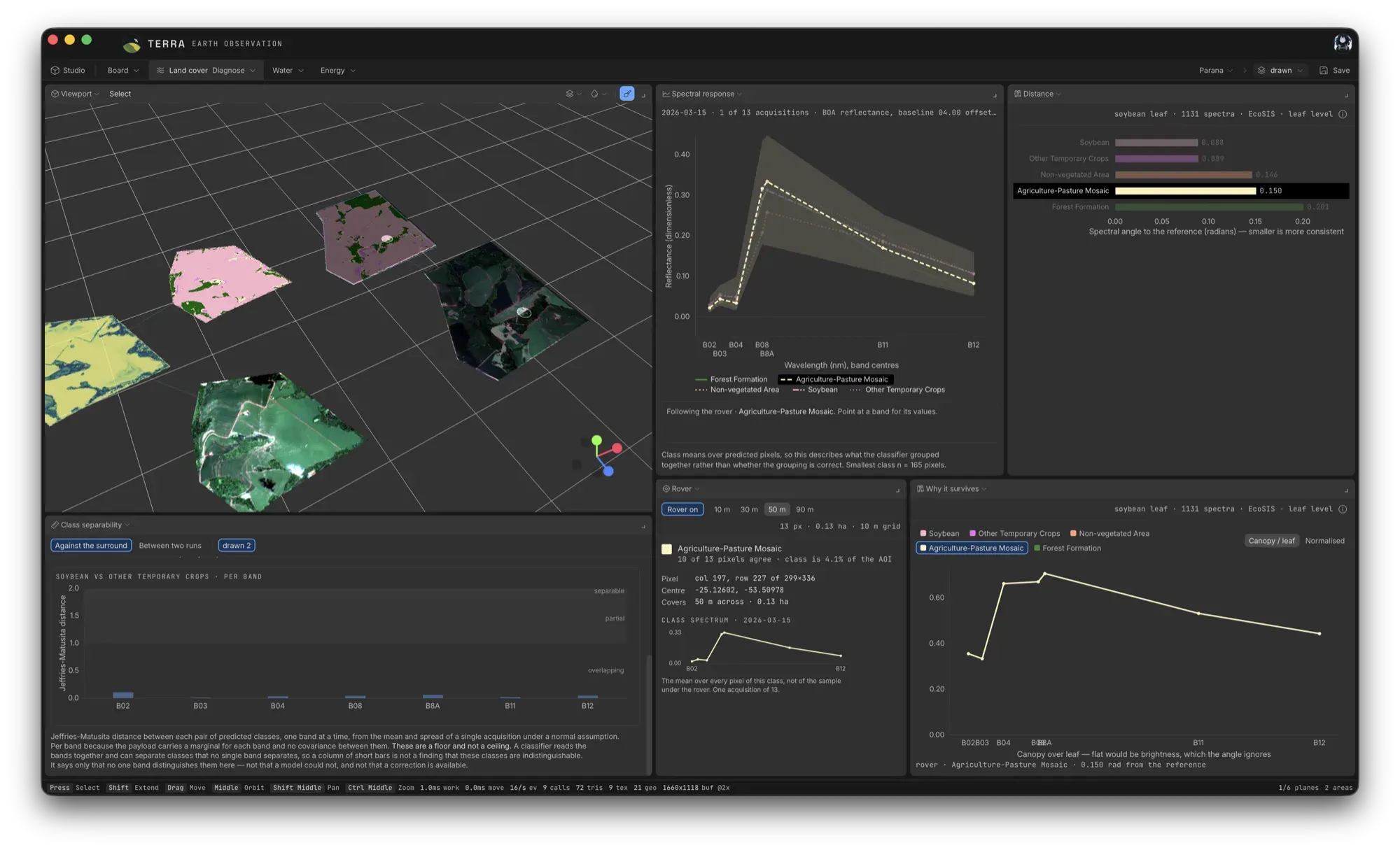
When a model does worse somewhere, Diagnose asks why: how far one area sits from another, and what each predicted class looks like spectrally.
Domain shift
Diagnose measures the domain shift between runs directly: symmetric KL divergence on NDVI, change-vector magnitude in training standard deviations, RBF MMD, and a per-feature shift table. These are computed on standardised samples when both runs carry a classify-time fingerprint.
Spectral response, in detail
- The mean reflectance of each predicted class, band by band
- The spectral angle between each class and a leaf-level spectral library
- A rover that samples the ground at a chosen footprint and reads the class under it
- How separable each pair of classes is, band by band (Jeffries–Matusita)
It diagnoses; it does not adapt.
!Current constraints
- Class means are taken over predicted pixels, so they describe what the classifier grouped together, not whether the grouping is correct.
- Per-band separability is a floor, not a ceiling: a classifier reads the bands together and can separate classes that no single band separates.
- The domain-shift report is not included in the research pack.
- Adapting the models to a shifted area remains research.